Hattar av (hats off) to those crafty, safety conscious Swedes as they have done it again. First the Volvo, now the Hövding!
To what am I referring? A clue: it was only a matter of time before air-bags escaped the confines of the car. Yes, that’s it, the invisible (inflatable) helmet has arrived!
Anna Haupt and Terese Alstin are the brains and entrepreneurial drive behind this exciting confluence of an air-bag and cycling helmet. “The instant we heard the word “invisible”, we realised that was what the world was waiting for. An invisible bicycle helmet. That wouldn’t ruin your hair.”
It seems their hairstyles are now being threatened by crowns rather than helmets. They have received a number of awards for their invention, along with a Swedish 2012 Innovation Award nomination. Judging by the success of Hövding it won’t be long before ‘invisible’ helmets will be appearing in your local bike shop.
No bike party will be complete without one and as a bonus, the video demonstrates that it’s gate-crasher proof. I’m just hoping the helium canisters are interchangeable with the CO2 versions so I can use it to re-inflate my tyre after a puncture.
Following my recent crash-test-dummy experience using a mountain bike and a tree, (that would be the one that left me with a shattered right arm and a dislocated left elbow, and operations on both)… I can’t wait for Mark II – the inflatable body-suit version!
JA TACK (yes please), SIGN ME UP!
I’m thinking it’s a must have for a sci-fi themed fancy dress party
Doug Gross (CNN) has provided a good background if you are interested.
“You should always be aware that your head creates your world.” Ken Keyes JR
In addition to respecting his head, Ken was an interesting guy. He was most famous as a personal growth guru and creator of the Living Love Method. Ken self-published 14 books before self-publishing was in fashion. He studied music, launched the Miami Opera Guild, was a naval intelligence officer, suffered polio, became a quadriplegic, then an inventor, launched a business that made US $25M in its first year …and married four times. You don’t have to agree with his methods or approach to life but there is no disputing that the now departed Ken, enjoyed a wealth of experience.
Which brings me to my point. There have been a number of commentators calling for the repeal of mandatory helmet laws for cyclists. Unfortunately these commentators are betraying cycling experience and the common sense espoused by Ken when he declared, “your head creates your world”.
The current debate on Australia’s mandatory helmet laws (MHL), has largely been driven by romantic notions and confirmation bias. Those in opposition to MHL selectively misuse statistics and unsubstantiated opinion, as can be seen by news articles referencing a cycling friendly and statistically safe Europe. If you were to take their position on face value, the exponents of this helmetless utopia would have us believe that it is perfectly safe to ride in Australian cities without a helmet.
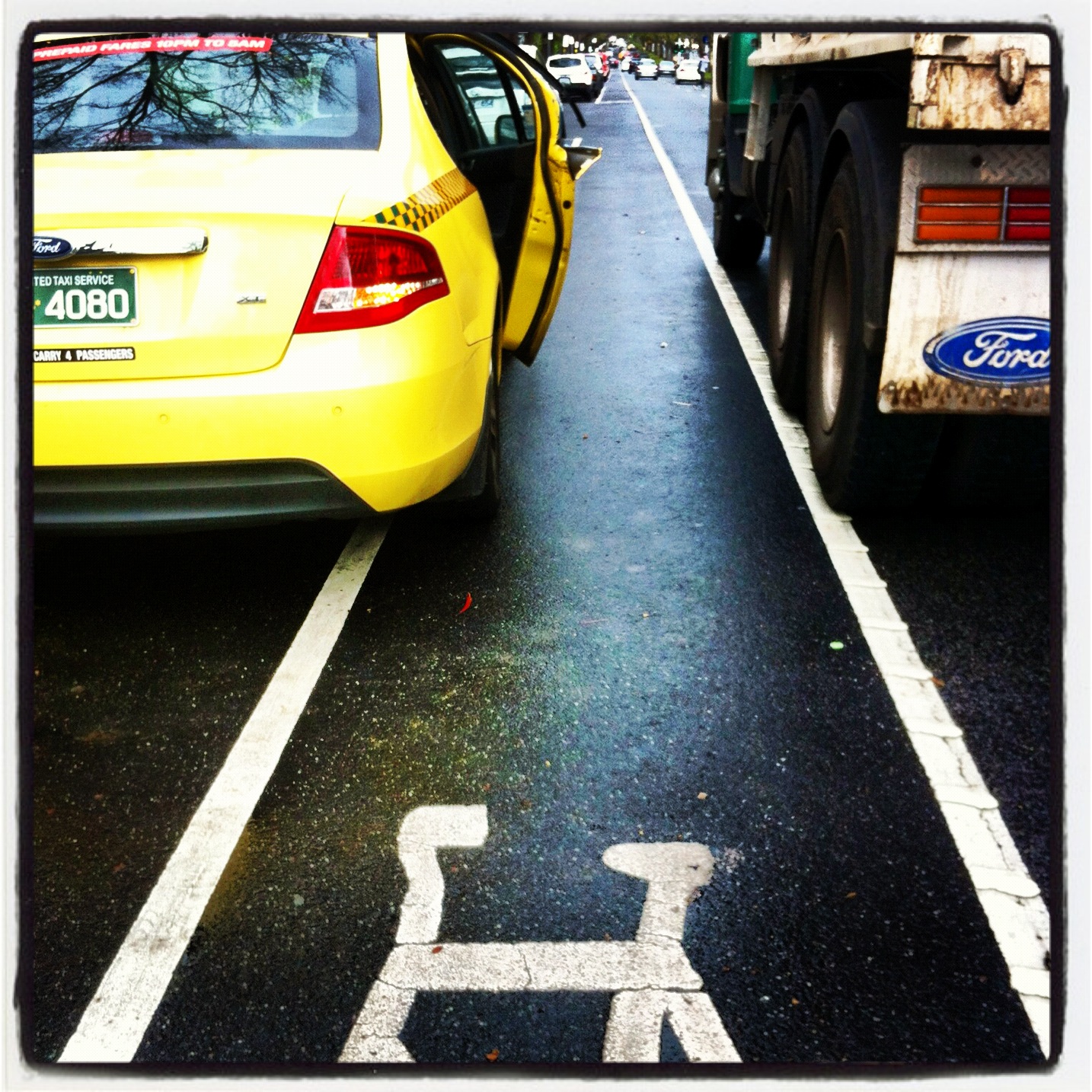
I arrived just after a passenger swung open his door …into a truck.
Recently comedians cum writers Wendy Harmer and Catherine Deveny hopped on the helmet-less, two-wheeled bandwagon. While their sentiment may be laudable, the comparison with Europe is unfortunately, laughable. Harmer describes her blissful park riding experience in London while bothcapture the European ideal with stylish and appealing helmet-free imagery of empowered women.
Danish-Canadian cycling advocate Mikael Colville-Andersen is featured by Deveny. Mikael uses the Monocal magazine list of the world’s most liveable cities to illustrate that cycling-friendly cities dominate. Melbourne was ranked in the top 10 but didn’t make Mikael’s cycling friendly list, nor does it mine.
Helmet Freedom is an anonymous website that advocates its namesake ‘freedom’, as the primary motivation for not wearing a helmet. It draws conclusions that MHL have failed to reduce injury rates; conclusions that have been disputed by a number of Australian health and scientific professionals. The assumptions drawn by this websiteare that mandatory helmet regulations inhibit the up-take of cycling and fail to reduce injury anyway.
The Institute of Public Affairs (IPA), better known as climate change deniers and partners of Gina Rinehart’s lobby group Australians for Northern Development & Economic Vision, have taken an unlikely interest in cycling. Steered by heavies of Liberal party politic and supporters of big carbon industries, it seems likely that the IPA aren’t all that interested in promoting a reduction of fossil fuel use and an increase in cycling infrastructure spending. None-the-less, Luke Turner points the finger at MHL as the prime reason for a lack of cycling up-take in Australia and the relative failure of our bike share schemes.
He lumps a varied collection of assumptions and selective misuse of statistics to support his notions. Given that this article was published by the IPA, I am left with visions of $2 a day open-cut miners riding helmet-less into the pit, on tandem cycles.
Michael O’Reilly, in an article published in The Age has also had a crack at the perceived failure of bike share schemes in Brisbane and Melbourne. MHL are singled out as the major reason for this apparent failure. “Most believe it comes down to Australia’s near-unique mandatory helmet laws, which are responsible for the lack of share scheme participation”.
Why are they wrong? What all of these critics fail to state, is that the highly successful share schemes in Europe are targeted at a very different demographic. In Europe, bike stations are strategically located to create linkages incorporating the city centre, train stations, commercial and educational centres and a lower socio-economic urban populace, residing in high-density living. This targeted placement provides residents with an affordable and effective alternative mode of public transport. In the city of Lyon, France I hired a bike as a tourist but during peak hours regularly found the central city stations emptied of bikes. Conversely, late in the evening I had to try several urban bike stations to locate a free space to return my hire. In Barcelona, Spain the bike share scheme is restricted to residents only. Private rentals are the only option for a visiting tourist.
In Melbourne the bike share scheme targets office-to-office commuting and largely ignores urban transport and tourist needs. Stations are scattered across the city and not placed near high-density living. There aren’t helmet dispensers close by and unlike Europe there are no safe, segregated and dedicated cycling routes to connect bike stations. It is little wonder office workers and tourists are reluctant to set off on a bike in Melbourne – the lack of safe, linking bike routes relegates cycling to the brave, experienced and assertive riders. Urban commuters default to car, tram, train or bus. The brave minority tackle the traffic, on their bike.
Europe boasts high numbers of cyclists and excellent bike share utilisation, thanks to effective targeting and infrastructure. However experience shows that there are greater factors at play when comparing to Australia. Those of us who have been fortunate enough to ride in cycling friendly Europe can confirm the comparative safety and pleasure of the experience. I’m sorry to say that I rarely enjoy that feeling of safety, acceptance and sheer pleasure when cycling in any of our capital cities in the east of Australia. Sitting in my local cafe I overhear two women who share my view.
Soon after I’m canvassing Maria and Annalise for their thoughts. Maria has just returned to from a three-month holiday, visiting her daughter who is studying in Copenhagen. She didn’t like bikes and said she wouldn’t ride one, said Maria, who then proudly showed me a picture of her daughter’s new white step-through, resplendent with basket. “It’s so easy to ride in Copenhagen and everybody does it – she soon changed her mind”, Maria said with a smile.
“What is it that makes Europe different to Melbourne”? I ask.
“Europe is set up for bikes, the infrastructure is planned for cycling, bikes are separated from cars and have right of way, said Maria.
I won’t ride without a helmet here but felt safe there…The culture is different (in Europe), drivers are more aware and give way to bikes, there’s mutual courtesy. Here they are just putting in bike lanes and really haven’t given it much thought”.
Maria’s view is one that mirrors my experience and I’ve had plenty on a bike. Cycling adventures have taken me throughout Europe, from a week on a re-cycled bike in Copenhagen to bike shares in French cities and bike hires in Spain and San Francisco. I have embarked on several road-biking expeditions, pedalling along the routes of Le Tour de France, up into the majestic expanse of the Pyrenees; the French and Italian Alps, the Ligurian coast, Rome and south of Salerno.
Here in my home city of Melbourne I cycle to work, suited and astride my Amsterdam style bike. On weekends I emerge from my virtual telephone box transformed into a middle-aged try-hard in lycra.
The most significant difference that Maria and I have experienced is one of culture. Cycling is an accepted part of European culture. As an example; I was on my first trip to France, lost to the sound of my own puffing as I laboured up a narrow Pyrenees road to the 1,700m summit of Col d’Aubsique. I looked back and was startled to find four cars crawling along behind me. “Oh-oh!” I thought to myself, with a notion of guilt and expectation of an earful of abuse. To my great surprise, I received friendly waves from the occupants of each of the cars as they made their way safely past. In Australia I make a conscious attempt to acknowledge safe drivers with a wave but unfortunately the majority of my encounters are negative. That negativity covers the full spectrum, from dangerously close encounters with cars, to impatient beeps, aggressive driving, yelled abuse and objects hurled from windows.
While cultural attitudes to cycling are one significant factor in creating an environment of mutual courtesy and respect, safe infrastructure is another major difference. European cycling friendly cities provide segregated and safe infrastructure, linking commuting routes in and around the cities. Unlike Australia, bikes are welcome to share bus lanes, footpaths, parks and public places. In return for these liberties cyclists ride sensibly and safely with respect for pedestrians and bus thoroughfare. Lycra clad cyclists ride slowly in bike lanes and public places, on route to training rides outside of commuting areas.
I would not ride in an Australian city without a helmet. We lack the infrastructure to protect and segregate cyclists from vehicles and importantly, we lack the socio-cultural acceptance of cycling as a legitimate form of transport. One deserving of respect for shared road use.
Councils would have us believe parks are unsafe for cyclists in Melbourne
The result of this is a standoff and hardened attitudes between motorists and cyclists. A small percentage of cyclists believe they can ride aggressively and train on shared paths and in commuting bike lanes. Many motorists display a lack of concern for cyclists’ vulnerability on roads and in bike lanes. Taxis and motorists constantly obstruct bike lanes forcing cyclists to detour into traffic. Lack of separation means ‘car dooring’ is a constant threat. In response the State Government launched a rear-view sticker awareness campaign – it has been an abject failure.
Today I had a lady beep and grumpily yell “get out of the way”, as I stood stationary in the middle of the road on my bike, waiting for a safe opportunity to cross. She had ample room to pass and the traffic in her lane was at a standstill 50m further on.
Last Thursday I was unfortunate enough to have 30 Rhinos, or one Melbourne Tram as the safety campaign advises, ‘nudge’ me from behind when passing. My daughter, riding in front had stopped, as she didn’t think there was enough room for the tram and us. She was right. When the tram hit me, my bike hit my daughters, and hers hit a parked car. The tram continued on it’s way until I slapped it to alert the driver to stop. The driver then assertively denied the incident saying, “You cyclists are all dickheads!”
Based on my experience and that many others, Australia has a long way to go to catch up on European cultural acceptance of cycling and provision of safe, segregated infrastructure. Until such time as we address awareness, attitudes and acceptance through education and widespread cycling infrastructure, lobbying for the repeal of mandatory helmet laws is misguided, divisive to the cycling community and distracting from the core issues.
I return to the safety of my local cafe and the manager Andrew, delivers me a coffee with his usual smile and ear-to-ear scar that signifies an alternate reality. Andrew is also a cyclist and the victim of a ‘car-dooring’ which speared him into the path of an oncoming car. Two months later he regained consciousness, six months later he was released from hospital. His life has slowly resumed with his job managing a busy Collingwood cafe.
“If I hadn’t been wearing a helmet I would be dead. There is no doubt about it,” says Andrew. I just think it’s ridiculous that a minority of people suggest that helmet laws are preventing people from cycling”.

 CRASHION