“You should always be aware that your head creates your world.” Ken Keyes JR
In addition to respecting his head, Ken was an interesting guy. He was most famous as a personal growth guru and creator of the Living Love Method. Ken self-published 14 books before self-publishing was in fashion. He studied music, launched the Miami Opera Guild, was a naval intelligence officer, suffered polio, became a quadriplegic, then an inventor, launched a business that made US $25M in its first year …and married four times. You don’t have to agree with his methods or approach to life but there is no disputing that the now departed Ken, enjoyed a wealth of experience.
Which brings me to my point. There have been a number of commentators calling for the repeal of mandatory helmet laws for cyclists. Unfortunately these commentators are betraying cycling experience and the common sense espoused by Ken when he declared, “your head creates your world”.
The current debate on Australia’s mandatory helmet laws (MHL), has largely been driven by romantic notions and confirmation bias. Those in opposition to MHL selectively misuse statistics and unsubstantiated opinion, as can be seen by news articles referencing a cycling friendly and statistically safe Europe. If you were to take their position on face value, the exponents of this helmetless utopia would have us believe that it is perfectly safe to ride in Australian cities without a helmet.
Recently comedians cum writers Wendy Harmer and Catherine Deveny hopped on the helmet-less, two-wheeled bandwagon. While their sentiment may be laudable, the comparison with Europe is unfortunately, laughable. Harmer describes her blissful park riding experience in London while bothcapture the European ideal with stylish and appealing helmet-free imagery of empowered women.
Danish-Canadian cycling advocate Mikael Colville-Andersen is featured by Deveny. Mikael uses the Monocal magazine list of the world’s most liveable cities to illustrate that cycling-friendly cities dominate. Melbourne was ranked in the top 10 but didn’t make Mikael’s cycling friendly list, nor does it mine.
Helmet Freedom is an anonymous website that advocates its namesake ‘freedom’, as the primary motivation for not wearing a helmet. It draws conclusions that MHL have failed to reduce injury rates; conclusions that have been disputed by a number of Australian health and scientific professionals. The assumptions drawn by this websiteare that mandatory helmet regulations inhibit the up-take of cycling and fail to reduce injury anyway.
The Institute of Public Affairs (IPA), better known as climate change deniers and partners of Gina Rinehart’s lobby group Australians for Northern Development & Economic Vision, have taken an unlikely interest in cycling. Steered by heavies of Liberal party politic and supporters of big carbon industries, it seems likely that the IPA aren’t all that interested in promoting a reduction of fossil fuel use and an increase in cycling infrastructure spending. None-the-less, Luke Turner points the finger at MHL as the prime reason for a lack of cycling up-take in Australia and the relative failure of our bike share schemes.
He lumps a varied collection of assumptions and selective misuse of statistics to support his notions. Given that this article was published by the IPA, I am left with visions of $2 a day open-cut miners riding helmet-less into the pit, on tandem cycles.
Michael O’Reilly, in an article published in The Age has also had a crack at the perceived failure of bike share schemes in Brisbane and Melbourne. MHL are singled out as the major reason for this apparent failure. “Most believe it comes down to Australia’s near-unique mandatory helmet laws, which are responsible for the lack of share scheme participation”.
Why are they wrong? What all of these critics fail to state, is that the highly successful share schemes in Europe are targeted at a very different demographic. In Europe, bike stations are strategically located to create linkages incorporating the city centre, train stations, commercial and educational centres and a lower socio-economic urban populace, residing in high-density living. This targeted placement provides residents with an affordable and effective alternative mode of public transport. In the city of Lyon, France I hired a bike as a tourist but during peak hours regularly found the central city stations emptied of bikes. Conversely, late in the evening I had to try several urban bike stations to locate a free space to return my hire. In Barcelona, Spain the bike share scheme is restricted to residents only. Private rentals are the only option for a visiting tourist.
In Melbourne the bike share scheme targets office-to-office commuting and largely ignores urban transport and tourist needs. Stations are scattered across the city and not placed near high-density living. There aren’t helmet dispensers close by and unlike Europe there are no safe, segregated and dedicated cycling routes to connect bike stations. It is little wonder office workers and tourists are reluctant to set off on a bike in Melbourne – the lack of safe, linking bike routes relegates cycling to the brave, experienced and assertive riders. Urban commuters default to car, tram, train or bus. The brave minority tackle the traffic, on their bike.
Europe boasts high numbers of cyclists and excellent bike share utilisation, thanks to effective targeting and infrastructure. However experience shows that there are greater factors at play when comparing to Australia. Those of us who have been fortunate enough to ride in cycling friendly Europe can confirm the comparative safety and pleasure of the experience. I’m sorry to say that I rarely enjoy that feeling of safety, acceptance and sheer pleasure when cycling in any of our capital cities in the east of Australia. Sitting in my local cafe I overhear two women who share my view.
Soon after I’m canvassing Maria and Annalise for their thoughts. Maria has just returned to from a three-month holiday, visiting her daughter who is studying in Copenhagen. She didn’t like bikes and said she wouldn’t ride one, said Maria, who then proudly showed me a picture of her daughter’s new white step-through, resplendent with basket. “It’s so easy to ride in Copenhagen and everybody does it – she soon changed her mind”, Maria said with a smile.
“What is it that makes Europe different to Melbourne”? I ask.
“Europe is set up for bikes, the infrastructure is planned for cycling, bikes are separated from cars and have right of way, said Maria.
I won’t ride without a helmet here but felt safe there…The culture is different (in Europe), drivers are more aware and give way to bikes, there’s mutual courtesy. Here they are just putting in bike lanes and really haven’t given it much thought”.
Maria’s view is one that mirrors my experience and I’ve had plenty on a bike. Cycling adventures have taken me throughout Europe, from a week on a re-cycled bike in Copenhagen to bike shares in French cities and bike hires in Spain and San Francisco. I have embarked on several road-biking expeditions, pedalling along the routes of Le Tour de France, up into the majestic expanse of the Pyrenees; the French and Italian Alps, the Ligurian coast, Rome and south of Salerno.
Here in my home city of Melbourne I cycle to work, suited and astride my Amsterdam style bike. On weekends I emerge from my virtual telephone box transformed into a middle-aged try-hard in lycra.
The most significant difference that Maria and I have experienced is one of culture. Cycling is an accepted part of European culture. As an example; I was on my first trip to France, lost to the sound of my own puffing as I laboured up a narrow Pyrenees road to the 1,700m summit of Col d’Aubsique. I looked back and was startled to find four cars crawling along behind me. “Oh-oh!” I thought to myself, with a notion of guilt and expectation of an earful of abuse. To my great surprise, I received friendly waves from the occupants of each of the cars as they made their way safely past. In Australia I make a conscious attempt to acknowledge safe drivers with a wave but unfortunately the majority of my encounters are negative. That negativity covers the full spectrum, from dangerously close encounters with cars, to impatient beeps, aggressive driving, yelled abuse and objects hurled from windows.
While cultural attitudes to cycling are one significant factor in creating an environment of mutual courtesy and respect, safe infrastructure is another major difference. European cycling friendly cities provide segregated and safe infrastructure, linking commuting routes in and around the cities. Unlike Australia, bikes are welcome to share bus lanes, footpaths, parks and public places. In return for these liberties cyclists ride sensibly and safely with respect for pedestrians and bus thoroughfare. Lycra clad cyclists ride slowly in bike lanes and public places, on route to training rides outside of commuting areas.
I would not ride in an Australian city without a helmet. We lack the infrastructure to protect and segregate cyclists from vehicles and importantly, we lack the socio-cultural acceptance of cycling as a legitimate form of transport. One deserving of respect for shared road use.
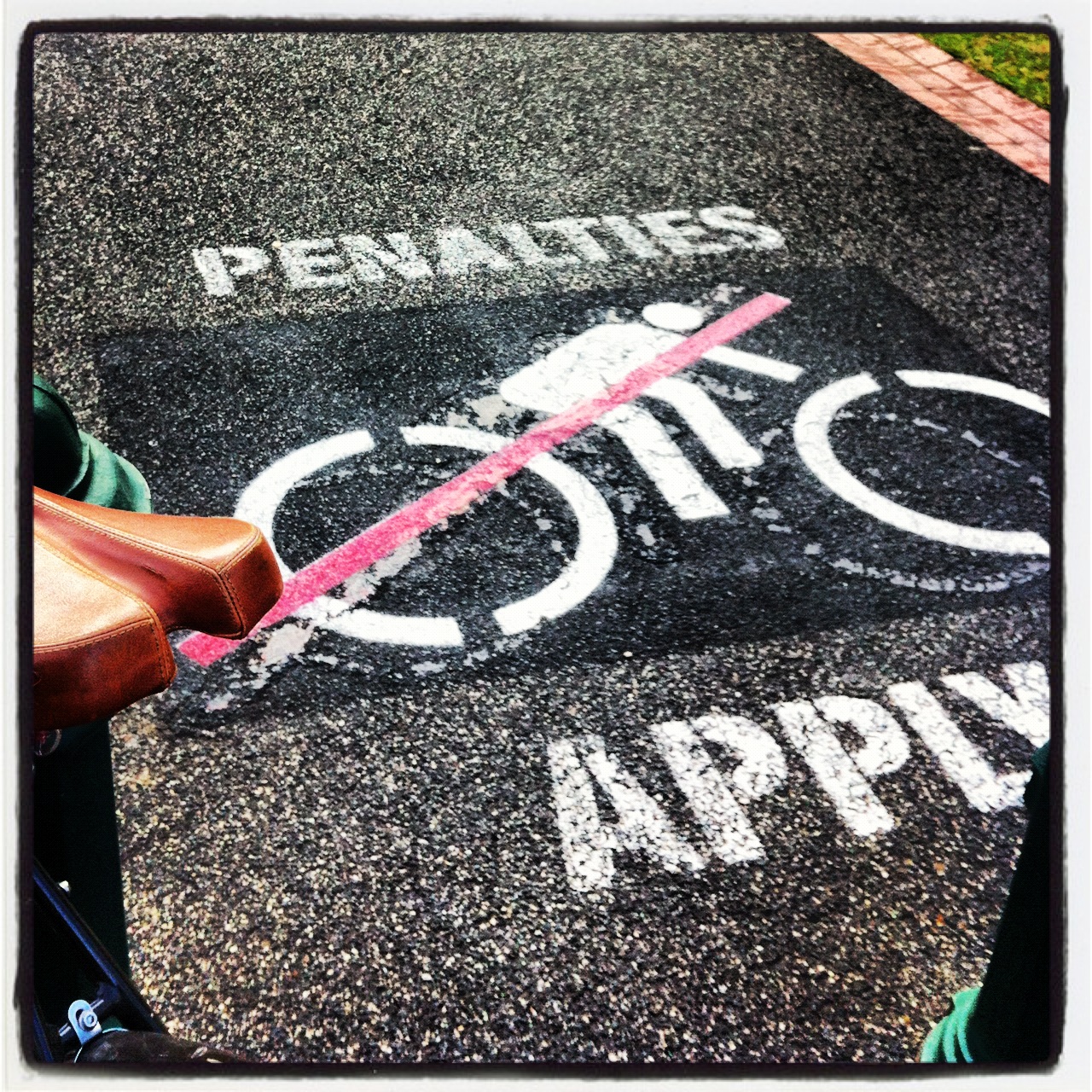
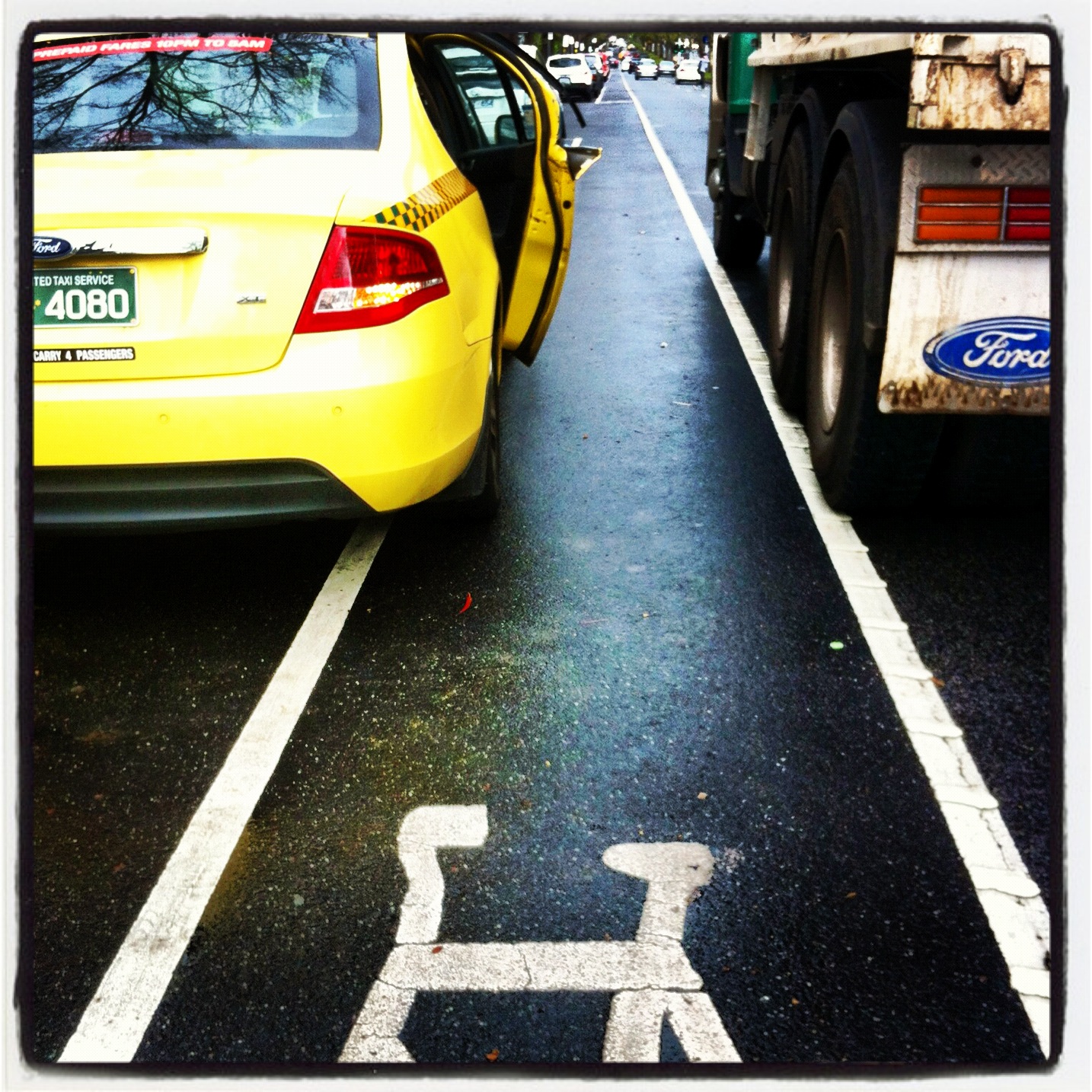
The result of this is a standoff and hardened attitudes between motorists and cyclists. A small percentage of cyclists believe they can ride aggressively and train on shared paths and in commuting bike lanes. Many motorists display a lack of concern for cyclists’ vulnerability on roads and in bike lanes. Taxis and motorists constantly obstruct bike lanes forcing cyclists to detour into traffic. Lack of separation means ‘car dooring’ is a constant threat. In response the State Government launched a rear-view sticker awareness campaign – it has been an abject failure.
Today I had a lady beep and grumpily yell “get out of the way”, as I stood stationary in the middle of the road on my bike, waiting for a safe opportunity to cross. She had ample room to pass and the traffic in her lane was at a standstill 50m further on.
Last Thursday I was unfortunate enough to have 30 Rhinos, or one Melbourne Tram as the safety campaign advises, ‘nudge’ me from behind when passing. My daughter, riding in front had stopped, as she didn’t think there was enough room for the tram and us. She was right. When the tram hit me, my bike hit my daughters, and hers hit a parked car. The tram continued on it’s way until I slapped it to alert the driver to stop. The driver then assertively denied the incident saying, “You cyclists are all dickheads!”
Based on my experience and that many others, Australia has a long way to go to catch up on European cultural acceptance of cycling and provision of safe, segregated infrastructure. Until such time as we address awareness, attitudes and acceptance through education and widespread cycling infrastructure, lobbying for the repeal of mandatory helmet laws is misguided, divisive to the cycling community and distracting from the core issues.
I return to the safety of my local cafe and the manager Andrew, delivers me a coffee with his usual smile and ear-to-ear scar that signifies an alternate reality. Andrew is also a cyclist and the victim of a ‘car-dooring’ which speared him into the path of an oncoming car. Two months later he regained consciousness, six months later he was released from hospital. His life has slowly resumed with his job managing a busy Collingwood cafe.
“If I hadn’t been wearing a helmet I would be dead. There is no doubt about it,” says Andrew. I just think it’s ridiculous that a minority of people suggest that helmet laws are preventing people from cycling”.
 CRASHION
An enjoyable read. I particularly enjoyed how you brought it all into perspective by ending it with Andrew’s story. Photos aren’t bad either 😉
Thanks Caroline. It’s well edited too, did you notice 🙂 Unfortunately Andrew’s story is a sobering reflection of the lack of driver awareness and suitable cycling infrastructure. I enjoy riding without a helmet in European cities (but always wear it when riding out on open roads on my road bike). Sadly, I suspect Australia is a generation away from adopting European attitudes to cycling.
You say you would not ride in an Australian city without a helmet. Fair enough, but why do you think we need a law making it mandatory for everyone in all circumstances?
You choose to ride without a helmet in some circumstances in Europe. Do you think Australia should have a law requiring Australians to ride without a helmet in Europe?
Good question Steve. I’ll attempt to summarise:
1. To me, helmet law hullabaloo is a distraction diluting the core issues of cultural shift, attitudes, education & safe cycling infrastructure. Focus on achieving safety for cyclists and then target change to MHL.
2. Are we arguing the efficacy of seat belt laws? No but sometime in the future vehicle travel (not as we know it today) will have automated anti-collision systems. Seat belts will be redundant, as will be the law. Until such time it would be fruitless campaigning for repeal of seatbelt laws.
My point is why are so many people (from my perspective), wasting their efforts targeting MHL, when it would be more pragmatic and productive to target infrastructure spend, or minimum distance passing laws, or the inclusion of cycling awareness for drivers license tests…and the list goes on.
3. The law doesn’t allow enforcement in foreign jurisdictions. However NB: travel insurance companies could make it an exemption condition if they perceived it to be a cost to their bottom line. Fortunately it’s safer to cycle OS than here, so I don’t envisage that occurring.
Are those points on target and valid? Welcome the discussion, thanks.
…and thanks for taking up the discussion.
1. I don’t agree that calling for repeal of the mandatory helmet law is a distracition. I think it is an important part of the package of core issues you listed. My two main reasons are (a) the effect of the helmet on physical safety and (b) the effect on subjective safety.
(a) In my opinion, the most convincing evidence available shows that while a bicycle helmet may protect from low impact cuts and bruises such as a young child might suffer while learning to ride at home, it does little to nothing to protect from an impact severe enough to have caused serious injury without a helmet. Worse still, a helmet increases the risk and severity of rotational brain injuries, which apparently are the most dangerous types of brain injury. I have some links to stuff on this if you are interested.
(b) Subjective safety is decreased. That is, with government imposing a law, and almost every cyclist wearing a helmet, cycling looks like a dangerous thing to do. This reduces the number of people prepared to ride, and that reduces the pressure on government to provide all those things in your core issues list.
David Hembrow has an article about the types of safety required.
http://www.aviewfromthecyclepath.com/2008/09/three-types-of-safety.html
2. The comparison with car seat belts comes up from time to time, and I think that is a distraction.
They are not comparable devices at all. I take your point about waiting until infrastructure and crash proof cars make seat belts unnecessary before removing the law. If bicycle helmets were harmless then I would agree. Wait decades for good infrastructure and let the government have its law in the meantime. But, as I said above, helmets are not harmless and we need to get rid of the law as soon as possible.
3. The point I was making with the law about us cycling in Europe was that just because you or I choose to cycle wearing or not wearing certain items doesn’t mean we need a law to make everyone do it that way.
I’m not sure, but I think you can be prosecuted in Australia if you exploit children for sex overseas, so I think the government could make us wear helmets in Europe if they thought it would get votes.
Seatbelts are often brought up in this debate as somehow comparable to bike helmets. As far as I know seatbelts have never deterred motorists from using a car for transport, whereas helmets have often been cited as a deterrent to using a bicycle for the same purpose. Given that the latter is a healthy, sustainable, and less destructive form of transport, it doesn’t make sense (from an urbanist or environmental point of view) to burden it with this law. (In a perfect world we would have saddled motorists with such a deterrent.) The question is whether one thinks the benefits of more people riding without a helmet outweigh the risks. Unfortunately in Australia we don’t think so, which is a great shame.
I should add that a lot of critics of the law are also strong advocates for better infrastructure and less car-centric urban planning, as these are proven methods that encourage more people to ride and keep them safe. I’m yet to be convinced that a helmet law is a necessary part of this mix.
Thanks for the feedback. FYI: I prefer to ride and usually do for the reasons you listed and will also add that riding is just way more fun than driving has or will ever be for me (& I do also own a car). I don’t buy the argument that helmets are a deterrent to ride. That isn’t plausible to me and I have not seen any evidence to support that view. I have seen surveys and do hear a lot of anecdotal evidence from immediate friends, (girls in particular) that they feel too intimidated on roads to ride and commute (participation rates mirror that sentiment). Some ride bike paths or local streets to cafes on the weekend but most don’t feel safe on the road with inadequate infrastructure.
I did question if there was any reluctance to use a helmet on account of it messing up women’s hair (as was quoted by a women in a recent Age article). In response my daughter was a tad offended and accused me of asking a ridiculous and demeaning question, insinuating that women were vain. I pointed out I was merely seeking validation of a public statement made by a women. She then huffed and noted that the wind would mess up her hair riding without a helmet anyway. Phew! 🙂
I strongly agree with your improved urban planning comments. That, along with targeted education, such as including cycling awareness in license testing and stronger legislative support which might include minimum safe passing distances for vehicles and onus of responsibility vesting with drivers.
We have helmet laws and are likely to be stuck with them, so I think energies are better expended tackling the other priority issues. Promoting freedom from helmets plays into the conservatives catch-cries. You know the ones, “irresponsible cyclists, red light runners, dangerous to pedestrians, no place in parks, keep out of bus lanes, get off our roads and stop slowing me down”.
Sorry to bother you again, Crashion. I just noticed these comments and a couple of your answers are misleading.
1) Helmet law is not a distraction from a cultural shift; it’s very much the impediament of a cultural shift by damning cycling as a dangerous activity, therefore discouraging many to cycle and stopping govt’s from creating infrastructure because they falsely and lazily believe the helmet is the panacea of safety. While cycling numbers remain so low, you just won’t get the infrastructure.
2) Seat belts. First, they are part of a car, so can be readily used, and their safety factor is far greater than a bicycle helmet for a cyclist. Still, efficacy is one thing, a law is a drastic means. People would still wear seat-belts as they would helmets, regardless of laws. Second, their job is to restrain, not protect. Hundreds of motorists a year still suffer severe head injury and death. A helmet would prevent much of that. The equivalent cycling safey device to a seat belt is a preventative device, like dedicated cycle paths. Third, seat-belt laws quickly became popular around the world. Did the same happen for bicycle helmets? No. Aus, NZ & UAE are it. Fourth, seat belts are not required for vehicles going less than 25kph. By your analogy, neither should a helmet for cyclists going less than 25kph.
3) This safety issue, do you really believe it’s so dangerous here? It’s not dangerous. Overseas, it’s just even less so. If it’s so dangerous, there should far more accidents. If it really were that dangerous, the activity should be banned, not create a law that falsley suggests by putting on a thin piece of foam not even designed for heavy impacts that you are safe when engaging in said dangerous activity. Considering the overwhelming cycling deaths in Australia today are by those wearing helmets, that proves helmets are not the great safety device that is being made to believe.
Saying the helmet law is not the issue is naive. It is the pivotal issue in broadening the cycling base and getting infrastructure built. I will never understand how any cyclist can be so thrilled that a fellow cyclist is persecuted with a massive fine for the lack of piece of foam on the head.
I’ll actually suggest a solution as part of a 2 year trial:
1) Exemption for dedicated bike paths. These are not danger zones at all. By making paths exempt, you might encourage cyclists off roads, even if that means travelling a little further.
2) Cut the fine to a sane and fairer $30. You still have your mandatory law, and it acts as an encouragment law, not a persecution law. Note: in Victoria, when the law first arrived it was $20. It progressed to $50 over time, before suddenly tripling under the previous state govt. This is more for revenue raising as the helmet-wearing rate was already exceedingly high at over 97%.
3) After 2 years, an exemption for adults. You need this to get the Bike Share programs moving. Otherwise, they are a waste of taxpayers’ money.
So the reason Australia should have MHL is because it’s dangerous here? Why is it dangerous? Cars! Do helmets protect against a car smashing your head? No. Is cycling really dangerous here? No. Less than 3% of road fatalities are cyclists. Why don’t you inflict your nanny laws on motorists and pedestrians if the key is saving lives? Because they are not a minority. Cyclists can be picked on. Most of all, as you state, Australia is an anti-cycling country. So what’s the best way to ensure it stays that way, promote that cycling is dangerous, and keep cyclists off the road? Helmet Laws!!!
Once you can condone your cycling bigotry, then tackle your blatant hypocrisy and discrimination. I can live on burgers and chips, get fat, booze-up each night, smoke and bake in the sun and get skin cancer – all disgustingly bad for my health. If I ride a bike – something that is inherently good for my health – I’m slugged a whopping $176 fine, the same as a speeding motorist, if I’m not wearing a mostly useless piece of foam on my head. Why? So bloody what. There’s never been a problem with masses of cycling deaths even before law, just as there isn’t the world over.
Repealling the law won’t automatically mean thousands will suddenly go bare-headed, become kamikaze, and kill themselves. No, it just means that the few that might go bare-headed, they won’t be treated as a criminal. If you’re so pro-cycling, how can you accept a cyclist being persecuted like this? That’s right. It’s about hating cylists and maligning them as much as possible.
Perhaps there are less than 3% cycling fatalities because people are wearing helmets? I have been hit by a car and knocked off. My head didn’t hit the car but it did hit the road resulting in a bruise not a fracture, my helmet suffered dents, and I had scrapes. I’ve also been car doored off my bike from by a car stopped in traffic. I just missed a pole and landed on the footpath. I’ve had three high speed stacks of my own creation (put it down to ambition exceeding ability), two resulted in cracked helmets that I had to then throw away, I had concussion from one. I had a quick release snap and sailed over the bars to skid along the road, I’ve had a cleat come out as I was out of the saddle powering which deposited me onto the road to skid along on my back, I’ve lost it in the wet and high-sided over the bars…and there have been numerous other ‘offs’. Roads are hard surfaces, so too are gutter edges and road furniture. I have pretty well tried most out for impact tests at one point in time.
I, like the majority of cyclists are more than happy to pull on a lid because we figure it gives us a better chance of not being injured. It might be as minor as a skid. Something as simple as gloves save hands from gravel rash scrapes, my helmet has on many occasions (as detailed above) saved my head from certain scrapes and more serious damage.
If you don’t wish to wear a helmet then that is your decision. Persecution you say. If wearing a helmet is the only persecution you have to worry about then I would think life is pretty good in the scheme of things. Focussing on helmet laws plays into the hands of the haters and is counter productive to achieving a safe riding environment that will, eventually see the repeal of helmet laws. In the interim we may eventually be lucky and receive exemptions for bike paths, councils might one day let us ride in parks at walking pace, we might be sanctioned to ride on footpaths. Sorry, I can see you feel strongly about it but I can’t see helmet laws being repealed until the building blocks of cultural acceptance of cycling and safe segregated infrastructure are in place.
Thanks for your feedback.
“Roads are hard surfaces, so too are gutter edges and road furniture.”
Since you mention gutter edges….
The Australian standard impact test is a drop onto a flat anvil from 1.5 metres.
The European standard has the same test drop onto a flat anvil from 1.5 metres but also includes a drop onto a curved anvil to simulate a gutter edge.
(That 1.5 metre drop results in impact at about 19.5 km/h by the way..not very high speed eh?)
An Australian rider might prefer to use a European standard helmet..or some other standard..but because we have a law that specifies only the Australian standard we don’t have that choice. The standard is supplied and owned by a company, SAI Global. You’ll have to buy it from them if you want to read it.
Wouldn’t you like to be able to choose which helmet standard you thought suited you best? You could, if the law was repealed.
Crashion, no, the fatality rate has always been that low, if not lower because motorists fatalities were higher in years past. Molly Meldrum fell off a ladder and spent 6 months in a hospital. Why not mandatory helmets on ladders? Dozens drown at beaches or fishing on rocks each year. Where’s mandatory lifejackets? Hundreds die of skin cancer. Why aren’t police out persecuting those baring their skin? Lung cancer, heart disease, obesity. On and on it goes and these true evils of society are allowed scot free. Most of all, hundreds still die in motor vehicle accidents, WHERE ARE THE MANDATORY HELMET LAWS THERE??!! Why discriminate and persecute a humble cyclist?
If a helmet did help protect you in cycling fall, why the hell would repealing helmet laws affect your behaviour to wear a helmet? This is the entire foolish fallacy of the issue. There’s an absurd conflation of “no helmet law” to “ban helmet wearing”. No! No! No! The issue is freedom from persecution for doing something inherently safe, healthy and good for the environment because some nanny do-gooders and typically non-cyclists want to enact a discriminatory law based on their selfish agenda. They’ll dare not enact one for motorists, or lifejackets for beach goers, because it would affect them.
I echo word for word your second paragraph. You know what? I did this before the helmet law and would still do it afterwards. The exception is shopping trips on my quiet roads, or cycling the beach paths that are free of cars. The helmet’s a pain in the backside to carry about and unnecessary on bike path and especially uncomfortable in hot weather. My solution? I don’t do it. I drive to shops and am restricted to short work commutes during summer. In 35+ years of almost daily cycling, not even as much as a close call.
The problem you helmet law proponents have is recycling all this glib emotion and hysteria. The priority we should have is first to encourage cycling, then second to encourage helmet usage. That can be done through advertising as they do with Slip Slop Slap for skin cancer and all the Road campaigns. Why not make helmet purchases a tax deduction? Instead of brutally fining a cyclist, maybe Police give a free helmet rather than government wasting helmet subsidies on the city Bike Share programs. I was in Copenhagen in 2008. Virtually zero wearing helmets. In 2011, about a third. In Washington DC, it seemed about 70%. No laws. People can make up their minds. They are not as stupid as you believe.
Sorry to say, the ultimate fallacy and scam is that helmets help promote safe riding. Wrong. Politicians are lazy and stingy. They believe the panacea is a helmet law because the real alternative of infrastructure is too expensive. Of course, police buy into this because of their precious road toll. Now the public buys into because mandating such equipment suggests the activity is so dangerous. These flimsy cyclists helmets are not designed for heavy crashes either. So the security is false, potentially causing cyclists to be more risky than otherwise.
I leave you with a simple question to ask yourself: What would happen if helmet laws were repealed? Do you really believe it would be suddenly armageddon, that all cyclists would go out with no helmet, that suddenly thousands of non-cyclists would invade the roads and kill themselves? Look to other countries, of which none other than Aus & NZ have full scale helmet laws, and their excellent safety records. Think of the 16mil trips on London’s BikeShare on roads far more treacherous than Australia and no fatalities or severe injuries, is cycling really that dangerous. Think of stupidity of fining a cyclist to the level of a speeding motorist, is that really fair?
Interesting and relevant point Steve. I’m in no position to pick a fight with Standards Australia. My last hemet was purchased on the basis of it’s light weight and ventilation as it was mid-summer and I was on my way to climb French mountains. Unfortunately it was smashed upon return to Australia. Fortunately, it was damaged in transit and not while it was on my head.
The irony isn’t lost on me that it is less safe to ride in Australia but the European helmet standard is more stringent. Thanks for pointing that out. I guess it comes as no surprise given German engineering excellence, the Swedish Volvo, NCAP standards and French wine and cheese being a safe bet.
I use a rule of thumb for my standard; that is, ‘a helmet costs as much as your head is worth’. I have the luxury of indulging my head but those on low incomes don’t enjoy that privilege. So point taken on inequity of standards and relative safety. However any helmet, properly fitted will afford some protection, which is better than none, up to the point of critical impact – when you may as well dive headlong into an empty pool.
As (sort of) interesting as the helmet standards discussion is, it still detours away from my primary points. Changing our riding environments and cycling attitudes will not just improve safety. Benefits will be realised in reduce health costs, environmental impact, infrastructure spending…the list goes on, and I’m sure you are well versed or you wouldn’t be engaging in this debate. However, I am still of the view that the current focus on MHL detracts from a more important and meaningful discourse. Thanks again and keep your rubber side down.
Howdy! Would you mind if I share your blog with my zynga group?
There’s a lot of folks that I think would really enjoy your content.
Please let me know. Thank you
Hi Eloisa, my apologies for completely missing your comment. I didn’t mean to ignore you I’m sorry! By all means, sharing is fine and thanks for asking. I will be active again in August with fresh content, blogging a (another) France cycling trip.
Cheers Mark